The Airing-Out Kit
How long a smell takes to fade from a room: the air changes counted from your own fan, a target set as a fold and not a percent, the time allowed for a room that does not mix, the source stopped first, and the fan sized for the time you have
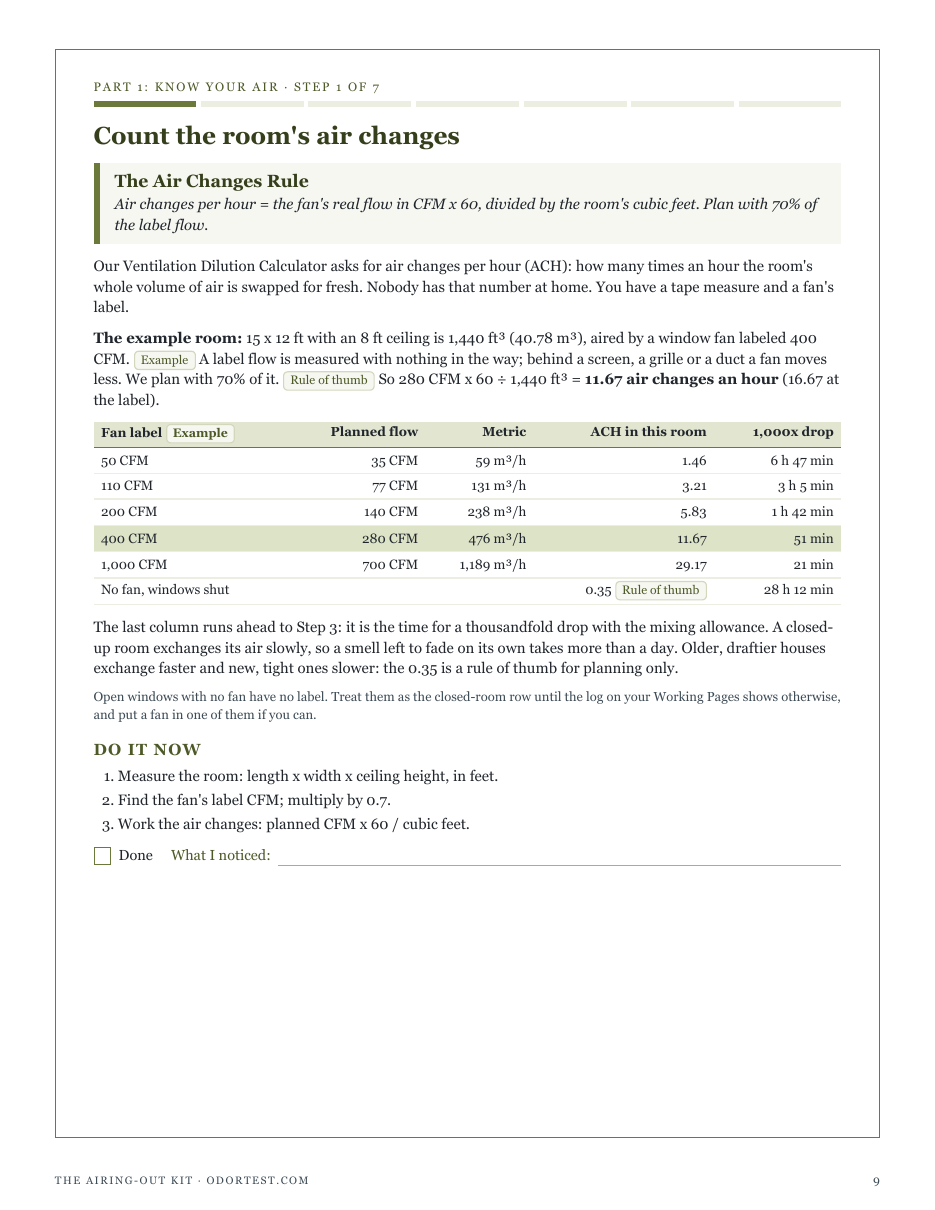
OdorTest's free tools each answer one question, and clearing a smell from a room asks them all at once. The Ventilation Dilution Calculator turns air changes per hour into a purge time, but nobody has that number at home; the fan in the window says CFM. Its default target, 10% remaining, sounds like done and is only a tenfold drop. And it assumes a perfectly mixed room with the source switched off. This kit puts the tools in order for one airing-out. It counts the room's air changes from a fan's label at 70% of its flow, sets the target as a fold using the Odor Concentration Calculator's bands, allows for a room that does not mix, stops the source first, and sizes the fan for the time you have, rounding every time and fan flow up. In the worked example, a 15 by 12 ft living room with a 400 CFM window fan, the label promises a thousandfold drop in 25 minutes; planned, it takes 51, and clearing it in half an hour needs a 680 CFM label. The 10% default leaves a D/T 500 smell 50 times over its threshold. Every figure is computed by the site's own calculators; the room, fans, smell and prices are examples, and the fan and mixing allowances are named rules of thumb. It times a smell and never says the air is safe: a gas smell means leave and call the gas company from outside, carbon monoxide has no smell so CO alarms are a must, and mold, sewer gas and chemical smells need a professional. Included: 23 printable pages with 7 steps, a room sheet, a fan sheet, an airing-out log, a reference table, and a personalised sheet worked from the numbers you enter in the calculators.
Look inside
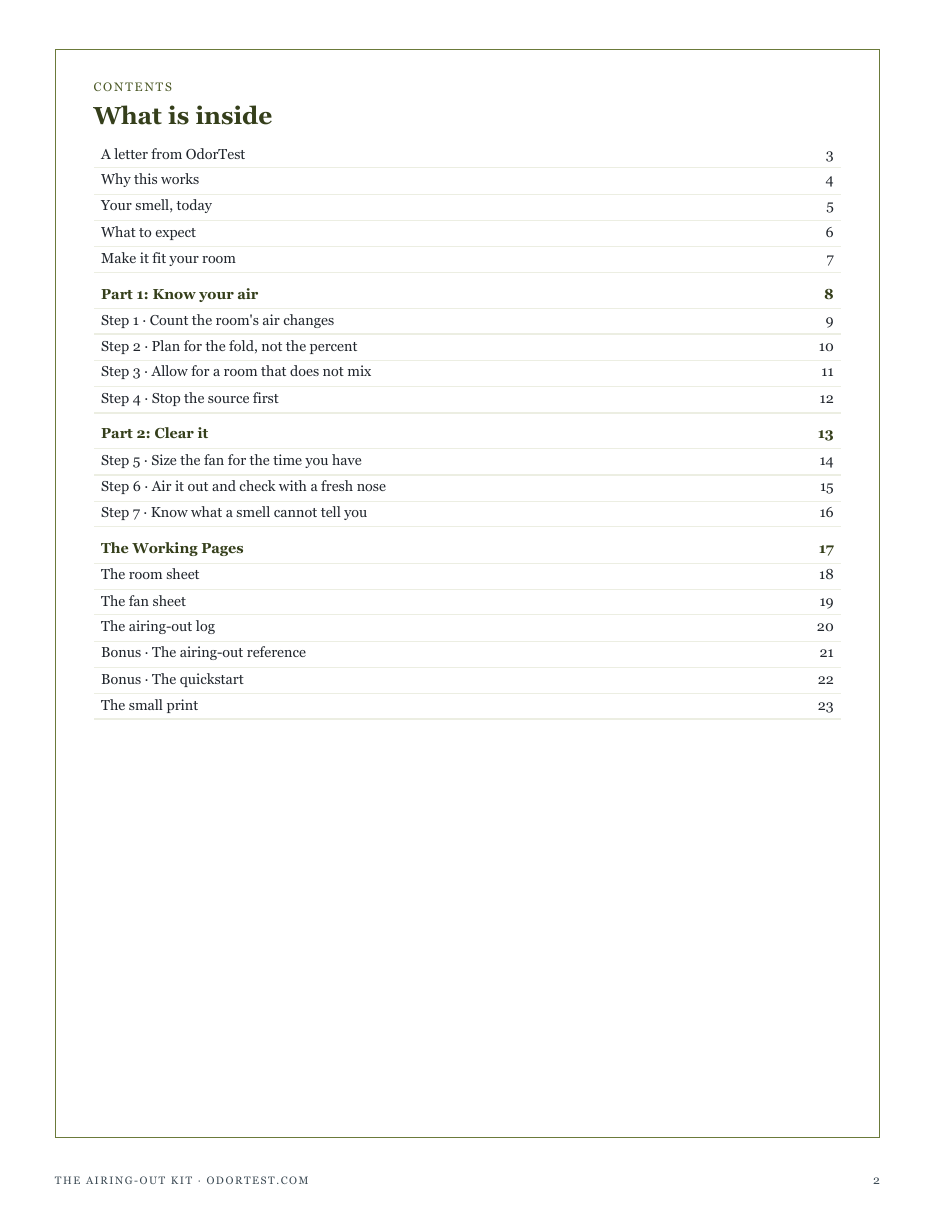
Two full pages from the kit, exactly as printed. Click either to read it at full size before you decide.
What is in it
- The Air Changes Rule: a room's air changes per hour counted from a fan's label CFM, planned at 70% of it, with a closed-up room for comparison
- The Fold Rule: the target set as how many times weaker the smell must get, and why the calculator's 10% default is only a tenfold drop
- The Mixing Rule: the time allowed for a room that does not mix, and how to give the air a path
- The Source-First Rule: why fresh air only holds a running source to a level, and where the clearing clock starts
- The Round-Up Rule: the fan label flow a room needs for the time you have, with both allowances, rounded up
- The Fresh-Nose Rule: the airing-out checked with a nose that has been outside, and what it costs in heat
- The Not-a-Safety-Test Rule: gas, carbon monoxide, burning, mold, sewer gas and chemicals, and what not to add
- Three working pages: a room sheet, a fan sheet and an airing-out log with a before-you-start checklist
- An airing-out reference: minutes to 10, 100 and 1,000 times weaker by air changes, and fan flow by room size
- A personalised sheet worked from the figures you enter in the ventilation and odor concentration calculators
- ✓ 23 printable pages
- ✓ 10 sections, worksheets and templates
- ✓ A second PDF worked out from the numbers you enter
- ✓ No account needed, just an email address
- ✓ Instant download; link valid 7 days
Price includes any taxes. Sold by GrabURL, who handle checkout and support. The charge appears on your statement as GrabURL.
The kit picks up where the free Ventilation Dilution Calculator leaves off. The calculator turns air changes per hour into a purge time for a perfectly mixed room; the kit counts the air changes from your own fan, sets the target as a fold rather than a percent (with the Odor Concentration Calculator's bands), allows for a room that does not mix, stops the source first, and sizes the fan for the time you have. It times a smell; it never says the air is safe. A gas smell means leave and call the gas company from outside, and carbon monoxide has no smell, so CO alarms are a must. The worked figures are examples.